

Case Studies
Media coverage is a product of strategy.
These case studies show how strategic go-to-market positioning and connecting company innovation to the broader market narrative helped generate feature national coverage.

Manufacturing Relevance: Stealing the Spotlight in the Portal Wars
Company: Flyhomes
Category: Real Estate, PropTech, AI
Outcome: National feature in Fast Company
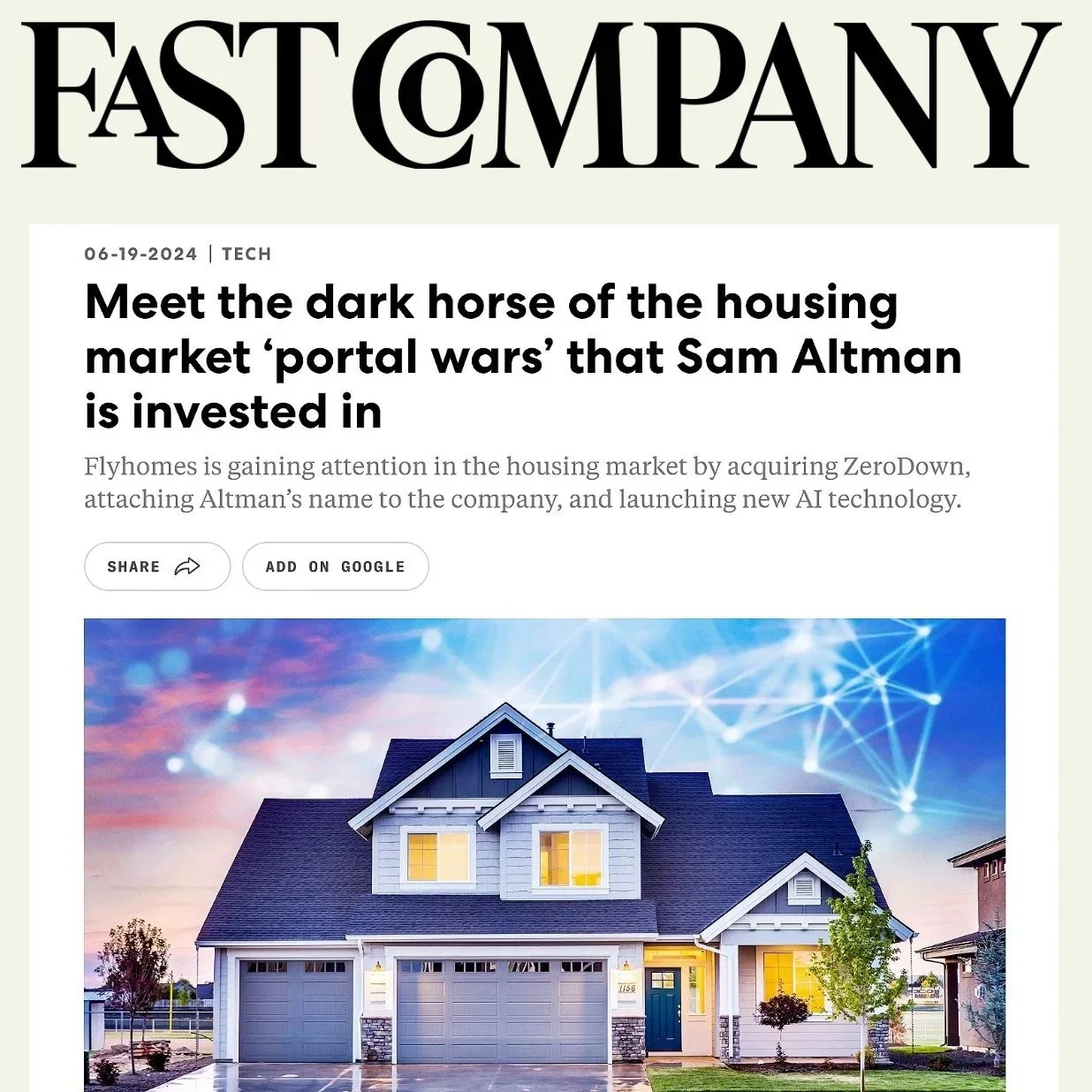
Coverage: “While Homes.com has all the spotlight in the so-called “portal wars,” it appears this month the competition got its dark horse: Flyhomes.”
The Challenge
The Portal Wars were - and remain - the battle between big real estate websites like Zillow, Redfin, Realtor.com, and Homes.com to become the one place homebuyers start their search - by controlling the listings, the information, and ultimately the relationship with the consumer.
Flyhomes had no logical reason to be part of the “Portal Wars.”
Flyhomes was materially smaller.
No marquee consumer wins.
No legacy portal traffic.
No billion-dollar ad budgets.
On paper, Flyhomes didn’t belong in the conversation.
But the industry was about to change - fast.
The Insight
The Portal Wars weren’t about portals.
They were about information friction - and that friction was about to explode.
By closely tracking regulatory shifts, consumer affordability pressure, and the downstream impact of the NAR settlement, we identified a looming inflection point:
Buyers were about to lose free, frictionless access to information — and no portal was actually solving for that reality.
The industry was framing the moment as a marketing war. We reframed it as a consumer trust and access crisis.
That reframing is what created Flyhomes’ opening.
The Strategy
Instead of competing on size, traffic, or spend, we positioned Flyhomes as the only company designing for what real estate would look like after the rules changed.
The narrative was built around three ideas:
The NAR settlement would fundamentally change how and when buyers access information.
Traditional portals are structurally designed to withhold insight to generate leads.
AI could eliminate information friction before buyers are forced into contractual relationships.
We didn’t pitch Flyhomes as a portal. We pitched Flyhomes as the counter-model.
The Execution
I designed and tightly orchestrated a reporter briefing that unfolded as a story, not a product demo.
Narrative flow:
Company origin and consumer-first mission
Structural shifts breaking the traditional buying journey
Why August 17th 2024 changed everything
Why existing portals couldn’t adapt without breaking their own business models
A first-ever look at a purpose-built AI search experience
The result: reporters weren’t told what to write, they were given the architecture to arrive at the conclusion themselves.
The Result
Flyhomes was elevated into the Portal Wars conversation as a credible, forward-looking challenger, despite lacking the scale of incumbents.
That narrative culminated in a national feature by Fast Company, framing Flyhomes alongside the largest players in real estate technology and positioning its AI portal as a legitimate threat to legacy models - ultimately leading to the sale of the portal asset Real Brokerage in July 2025.
Why This Matters
This case study isn’t about a single article.
It’s about proving that earned media doesn’t follow results, it follows insight.
When you deeply understand:
• where regulation is headed
• how incentives are breaking
• and what consumers will need before they know they need it
You can manufacture relevance, even when the scoreboard says you shouldn’t.
That’s the work.

Creating a Category: From Cash Offers to Power Buyers
Company: Flyhomes
Category: PropTech, Real Estate Innovation
Outcome: National feature in Business Insider
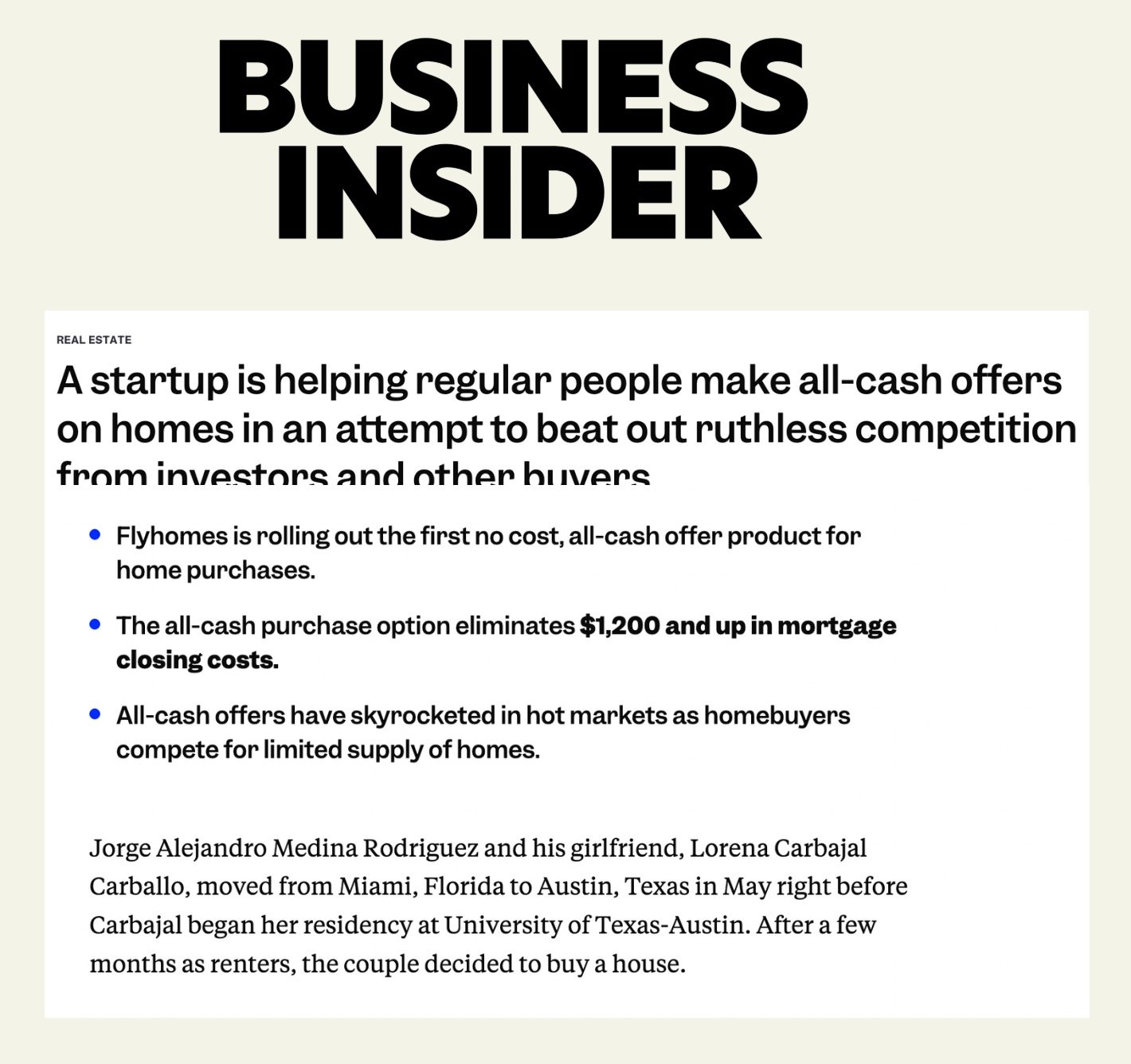
Coverage: “Flyhomes is helping regular people make all-cash offers on homes in an attempt to beat out ruthless competition from investors and other buyers.”
The Challenge
Flyhomes had developed a novel product - a no-cost, all-cash home offer program - at a time when most consumers couldn’t compete with deep-pocketed investors and wealthier buyers in bidding wars, but the market narrative was dominated by traditional financing and conventional real estate agents.
The product itself wasn’t a guaranteed blockbuster - all-cash offer services existed - but none had successfully framed this innovation as a democratizing force for everyday buyers. Flyhomes needed to prove to both consumers and the press that this wasn’t a niche service, but a systemic solution to a widespread market problem.
The Insight
The housing market in late 2021 was blisteringly competitive. Sellers were often flooded with multiple offers - many all-cash - leaving average buyers priced out or outbid. While all-cash sales had always existed at the high end, they surged in importance: all-cash offers were 23% of home purchases in mid-2021.
Yet, the average buyer rarely had the liquidity to actually make a cash bid. That gap between desire and ability was the real story, one that wasn’t about Flyhomes as a company, but about the structural inequity in homebuying. That was the narrative path we pursued.
The Strategy
Instead of pitching the product as just another real estate offer tool, we framed it as:
A market equalizer - allowing regular buyers to compete with institutional investors and cash-rich buyers
Consumer-first innovation - made available with zero additional cost or lender constraints
A cultural signal about how the nature of bidding wars had shifted in the modern housing market
That strategic framing planted the seed: this isn’t a product feature, this is a trend force. Reporters immediately saw broader industry relevance.
Using this narrative, we provided Business Insider with real stories — e.g., a first-time homebuyer couple who beat multiple high bids using Flyhomes’ all-cash offer with reduced closing costs, illustrating true consumer impact.
The Execution
We aligned the pitch to Business Insider’s core interests:
Timely Trend + Human Impact + Expert Commentary
• Trend: All-cash offers overtaking bidding wars
• Human: Couples and families who would otherwise keep losing
• Authority: Flyhomes CEO explaining the competitive dynamics
We positioned Flyhomes not just as a company doing something cool — but as a window into how the housing market is changing for millions.
This tactical alignment - narrative + timing + compelling examples - drove significant press pickup.
The Result
Business Insider positioned Flyhomes not merely as a startup offering all-cash bids, but as the consumer-first innovator redefining who gets access to cash power in homebuying.
The coverage helped Flyhomes own the narrative around “all-cash offers for everyday buyers,” establishing the company as the originator of a new PropTech category: power buyers — a model that gives regular consumers the competitive advantages of cash without forcing them to become speculators or sellers.
Critically, this framing placed Flyhomes in direct contrast to iBuyers. Where iBuyers used capital to extract value from the market, Flyhomes was shown using capital to empower buyers, repositioning cash not as a tool for institutional advantage, but as a consumer protection mechanism in an increasingly ruthless housing market.
Rather than a fleeting product mention, Flyhomes emerged from the coverage as the antithesis to iBuying — a company using financial innovation to level the playing field, not tilt it.
Why This Matters
This case study illustrates how strategic narrative design can create an entirely new category — not just awareness for a feature.
Flyhomes didn’t simply introduce an all-cash offer product. Through deliberate framing, timing, and editorial positioning, the company claimed ownership of the “power buyer” concept, reshaping how the market understood cash offers, competition, and consumer agency in real estate.
That shift — from product to category, from feature to philosophy — is what turns earned media into a durable strategic asset.
This is the difference between generating coverage and manufacturing meaning — and it’s exactly the kind of work The Kroll Company is built to deliver.